Tuesday, September 6, 2016

The Garden of the Earth: Waves at Wollaston Beach, Wind at Great Esker


            The waters thrash at Wollaston Beach. We park in our usual place. In this, the safest, most pacific of harbors, the water is almost always flat. Little ripples after a strong blow, and occasionally in deepest, raw-throated winter, whitecaps comb the tops of the driving stream. That's peak action for Quincy Bay, a vast southside chamber of Boston Harbor. From here we can see the tip of Boston Light, the country's first lighthouse, only on occasion.
            We have just come from a shoreline park in the neighboring town of Weymouth, called Great Esker Park. The strip of parkland lines the shore of estuarial body of water called the Weymouth Back River (photo left). On the other side of the river lies a complementary riverside park, this one is now contained within the town of Hingham, called Bare Cove Park.
            Weymouth's park however preserves the distinction of "Esker," the term for the geological formation that distinguishes it from all the other parks in the region, probably the state. The esker is defined as "a serpentine ridge of gravelly and sandy drift, believed to have been formed by streams under or in glacial ice."
            The "great Esker" of the park was formed 12,000 years ago. In geological time, that's only yesterday. But keep in mind that all of human civilization dates from the retreat of the glaciers in the last (or most recent) ice age. In Great Esker Park, the ridge winds around (and close along) the banks of the Back River facing generally south, and shortly encountering an open-water marsh on its north side.
            Here you can walk on a scrubby ridge-top trail -- yellow-brown, dirt-dry and sandy underfoot, trailside chest-high scrub oaks forming their acorns -- encountering neighbors such as the women walking and training their identical black labs. A young mother loping along after her preschooler through the thin trees toward the river bank. Three, and then four, identically dressed teenaged boys in black T's and jeans hanging out on the pavement, trying to talk away the September holiday afternoon with gaps of self-conscious silence rolling in, as they will.
            We were one of them. We roll past like an invisible cloud of silence through their anchored midst, since no one dares voice a word when an old person is within hearing. Potential "fox patches" everywhere (the vernacular pronunciation, that is, of  'faux pas.')
            I feel we could begin a network TV 'limited series' right there.
            Our America: everyone comes from a 'non-traditional' family unit. Single parent. Single parent of either sex, plus parent's boy or girl friend. Mom, Mom's mom, and baby. Maybe baby is now adolescent. People who raise dogs lovingly, lavish love on them, like children.
            Beautiful loving dogs. Troublesome teens.
            So we walk until we get to the place where the tide from the estuarial river flows over a sandy barrier into the already swelling marsh. It looks like the trail continues up and down on the other side, but you have to walk through the water to get there. The day is cool, gray, excited by stalled tropical storm blow-off, and not exactly wading weather unless you're the hardy types in some other kind of TV show, or desperate like one of Dickens's escaped transportation prisoners. I know I'm not getting my sneakers soaked; I've pretty much passed that stage in life.
            We engage one of the dog owners. "The tide's high," she tells us, "so you can't get across."
            Ah yes, we have speculated on that circumstance.
            We're all very friendly and cheery about reaching this agreement.
            I think it's the wind, steady and excitable; but not fierce or freezing or uncomfortable, or in any way unpleasant. It pumps up people's moods. And you just have go a little ways inland to escape it. The calendar says it's still summer, it's Labor Day weekend, the traditional end of the easy season. You might still be able to sit outdoors for your picnic. (We have just done so the day before, everybody dressed for summer and feeling it's fall). But it's surely not a "beach day."
            Confession: the only time I have donned a bathing suit this summer was for an 'early season' June day in Greece, when we splashed about happily in the aqua water. Greece makes you do things that the Massachusetts shoreline (or anywhere else) hardly ever encourages.
            The nice lady with the black labs tells us that another trail leads to the paved road, where we began our venture and then quickly abandoned for the more adventuresome gallivant up on the ridge trail. The road will take us beyond the marsh where we can pick up the continuing trail along the river.
            We do all that, passing the black-clad boys, and enter an even more pronounced ridge walk that, I foretell, will go on and on. We take it just a little ways, before running out of adventure fuel.
            Besides, we have to go see the waves breaking on Wollaston Beach, where the waters thrash against the seawall. It's a rare sight in the reliably (tediously) flat water of Quincy Harbor. We park with our headlights facing the seawall, the punch of the ocean breaking into a thousand stings of chilly spray splashing on the car hoods, flecking with ocean chill our hands and clothes and hats and averted faces. Staining our windshields with the print of the sea.

Monday, September 5, 2016

Garden of the Seasons: The Pleasures of September


            We can use our own judgment to decide whether summer is over. By the definition their industry uses, the meteorological science people claim it is. They divide the seasons by the whole month method, so autumn for them begins on Sept. 1. Summer began its three-month run June 1. Winter begins on Dec. 1.
            The astronomical calendar, following the movements of the sun more exactly, extends the three-month run of summer out to Sept. 22, when the sun's apogee is directly above the equator.
            Whichever season we assign it to, to me the first days of September ring in a change. Now you always hear the crickets at full voice when you venture out at twilight. You get a cool day, and probably a couple of rainy days too at the month's beginning. (Still waiting.) In September I go around the house closing windows first thing after getting out of bed. I work on remembering where I put the long sleeves; the 'wind-breaker'; socks. Wonder why the flip-flops are still hanging around next to the front door.
            And even though it's been years and years since I've had any personal connection to the academic calendar, I'm certain I still feel a change in the air when the neighborhood turns another page on the calendar. I stand outside my house in the hours before noon and listen hard. What is that sound? Is it silence?
            Some segment of the neighborhood's population has been  significantly emptied. People who live next to schools have a different opinion.
            The silence has many causes. Landscaping electronics continue this month, but at a reduced frequency. People are motivated to keep their lawns trimmed for 'summer.' After summer vacation, that impulse dwindles.
            But whether September is really still summer or not, it offers many of the same pleasures we gobble up in the 'vacation month' of August. Our son, who lives in a Midwestern city where the humidity lingers, reminds us when he visits that August is a beautiful time in New England. If you're not a commercial farmer, August is the easiest month of the year to do whatever you please; or nothing, if that's what pleases. Lots of sunlight; but as a rule little humidity. Guess what, September comes right behind it.
            Garden lovers have no trouble finding something to keep the flame going. The first weeks of September offers the last happy-go-lucky days for late summer standbys. Sweet William (second photo). Tall phlox (photo at left). Cosmos. Zinnias. Cone flowers and Rudbeckia (both seen in third photo down). The morning glory are still climbing. The PG hydrangea (fifth photo), in this year-after last year's rescue-transplant, gives us one beautiful, enduring bloom.
            The butterfly bush (Buddleia: top photo, with butterfly), during the last two years at least, is peaking. Our red-flowering Coreopsis is on a second bloom (sixth photo). Potted annuals are going great guns.
            A perennial called "Blue boas," or Agastache, has continued flowering from mid-summer on. The blue balloon flowers has some second blossoms. A few day lilies as well.
            With so many plants still flowering, I find satisfaction in cutting back the plants have flowered, done their thing, had their moment in the sun, and now are wilting. Removing some layers of mid-summer lush allows the remaining color peaks to shine. Besides, it's a lot less work than undertaking the significant transplanting I put off every year.September's too good not to enjoy it while it lasts.

Saturday, September 3, 2016

The Garden of History: From 1927 to 2000

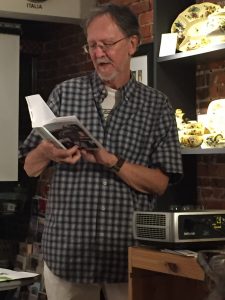
16slreadexcerptBoston's North End, an Italian-American neighborhood for a hundred years, has an attractive new book store, I AM. The store hosted a program that included long-suppressed film footage of the Sacco-Vanzetti funeral march, a reading from the published letters of Nicola Sacco and Bartolomeo Vanzetti, and my presentation on "Suosso's Lane."
            The movie newsreel film footage, taken of the Aug. 27, 1927 funeral march following the unjust executions of the two Italian immigrants, was suppressed by the American government, which told movie distributors to destroy the prints. The funeral march drew an estimated 200,000 people, the largest public gathering in Boston until recent times. The government sought to discourage all future attention to the Sacco-Vanzetti case, which damaged American prestige abroad. In recent years some damaged footage was discovered and restored. Historian Robert D'Attilio showed the footage and commented on the heavy police presence at the start of the march from downtown Boston. An attempt to re-route the march from certain streets failed.
            David Rothauser, who produced a film entitled the  "The Diary of Sacco and Vanzetti," then read two letters from Nicola Sacco during his imprisonment, including a final letter to his son, Dante. He also read a celebrated statement by Bartolomeo Vanzetti from the last days of his life in which he calls the ordeal of his and Sacco's suffering a "triumph" for educating society on the need for greater justice. The writings of Sacco and Vanzetti remain in publication in a Penguin paperback.
           I spoke on, and read a few brief excerpts from, "Suosso's Lane," my novel based on Vanzetti's life in Plymouth, Mass., and the relationship between his times and our own.  Here's an excerpt from my talk:

            But the world does not end in 1927, with the executions of Sacco and Vanzetti. History in America, as everywhere else, goes on.
            In my novel "Suosso's Lane," the details of the case are seen and discussed from perspective in the year 2000. We are in a new millennium when a young couple moves into a certain house on Suosso's Lane because the rent is manageable and the husband has his first real college teaching job close by. My characters discover that North Plymouth still has some of the characteristics of its working-class immigrant origins -- more affordable housing there than in most regional communities, more working class families and working poor. My young academic (I name him Mill Becker), a history teacher who has yet to find his true subject, learns to his surprise that a key figure in an internationally famous case in which the bigotry and the shortcomings of American justice scandalized the world, lived in apple-pie, Thanksgiving story, squeaky-WASP Plymouth at the time of his arrest.             
            Mill's interest is piqued. He looks for people to talk to. He looks into the historical conditions that produced the infamously flawed and prejudiced trial that convicted two men of murder without substantive evidence, but because of their political beliefs, the national mood of fear of radical violence or Communist revolution, and because of a widely held prejudice of the time against people of their national origin. To get an idea of how 'typical' native-born American regarded them, for 'Italians' substitute Muslims, Mexican criminals, or 'illegals' in today's partisan political discourse. In the course of his research Mill also discovers the existence of pre-World War I America, a time in history when lectures on free love by the anarchist Emma Goldman were widely attended throughout America, when almost a million votes were cast for the Prairie Socialist Eugene V. Debs (in the presidential election of 1912), when the ruling class faced challenges from both left and center, from the anarchist guru Luigi Galleani and the anti-monopolist Theodore Roosevelt; when an array of left-wing movements and theories (and some right-wing ones) challenged the status quo, ranging from the Farmer-Worker parties in Minnesota and other states, to the racist Jim Crow movement of the former Confederacy. Also a time when other major issues and causes were passionately debated: women's suffrage. Temperance, an idea that addressed the symptoms of poverty but not the cause. (Think "drugs," and substitute 'the evil of drink.') It led to Prohibition.
           It's a period of American life that that our own times appear to have largely forgotten, a time of relatively unfettered radical agitation that came to an end with the Red Scare.

Thursday, September 1, 2016

Garden of Verse: Two Poems from Lebanon


            Two poems published last month in Verse-Virtual.com date from our recent, early summer visit to Lebanon. Both have their origin in our persistent wanderings in Beirut, both a magical and a very real city. Over a dozen years we've seen the evidence of the damage from the city's war years diminish, the luxury hotel towers go up, and, more recently, a growing concern that the traditional architecture of the Arab Mediterranean city -- Arab style houses, Ottoman buildings: ornate balconies, iron gates, tall windows, open stairwells, courtyards, rooftop gardens -- is giving way to new buildings that lack the charm but raise the rent. It's easier and more profitable to build a new building with modern infrastructure than preserve and restore the beauty of the old.
            Western cities have been fighting this battle for years. Now it comes to old cities in developing countries that attract investment.   
            Anne and I have been taking walks on our own in Beirut on the last few visits. Given Smartphone technology we're probably past the point of having to stop high school kids who study English to ask for directions back to our daughter's neighborhood. Probably; hopefully.
            Plenty of the old is still around. Wood and stone have long memories. Some moments find you and stop you cold. No one has found a reason yet to knock down a piece of wooden wall in the photo above. Here's the poem:


Old Wooden Doors  
(after a photo taken on a side street in Beirut)


What faces do we see 
in the bone mirrors of long-ago trees?
A long-closed portal 
to an unknowable life,
lost decades before like the city that was, 
hidden beneath the mask 
of an ancient plague called simply "the war."
No war now.
Merely the routine clamor 
of the mind-fogging traffic.
This wall of doors has taken the veil
Patient as the ages, it watched a city crumble,
reclaim its pieces 
burred with time like furred candy,
make up its face again
smile and grimace in the lightweight days of not yet summer, 
a day that lets the caged bird sing
from the balcony.


             Two years ago on a previous visit we were surprised to find women sitting on the sidewalks of a busy commercial district begging, with their children beside them. Well, of course, after three years of devastating civil war an estimated one million Syrian refugees were trying to survive in neighboring Lebanon, a country the size of Connecticut with its one big city. What did I expect?
            I wrote a poem called "Sidewalk Madonnas," that was published in a few places, and a commentary that the Globe put on its digital edition. Unhappily, poems don't stop humanitarian disasters.
            Last summer, two more cataclysmic years later, things are that much worse for the war's displaced persons. You can no longer hand a low-denomination Lebanese Lira note to a black-clad woman and go unmolested on your way.
            This poem describes that experience.


I Flee Them Now  

I flee them now,
the feral beggars of the Syrian Catastrophe,
that fiery execution and slow-burn decomposition of a nation
in which the New World Order
dumbly colludes, rubbing its two-faced chin
Why should they not run me down,
strip me of value, market my flesh and bones,
render my trace elements useful in the end?
I do no good for them now
my tongue dumb, my outrage numb,
my well-intended prayers for peace of no account
when what's required is salvation on-the-ground 

Robbed of their childhood,
denuded of home, country, kinship, future,
stranded in a world of strangers,
why not fling their hungers at the impotent bystanders
whose bellies are full,
whose tongues fail to shake the palaces of power
whose fortunate existences mock their stolen lives?
I have no country to give them.

(These poems and many others can be found at Verse-Virtual.com. Here's a direct link:

http://www.verse-virtual.com/robert-knox-2016-august.html )